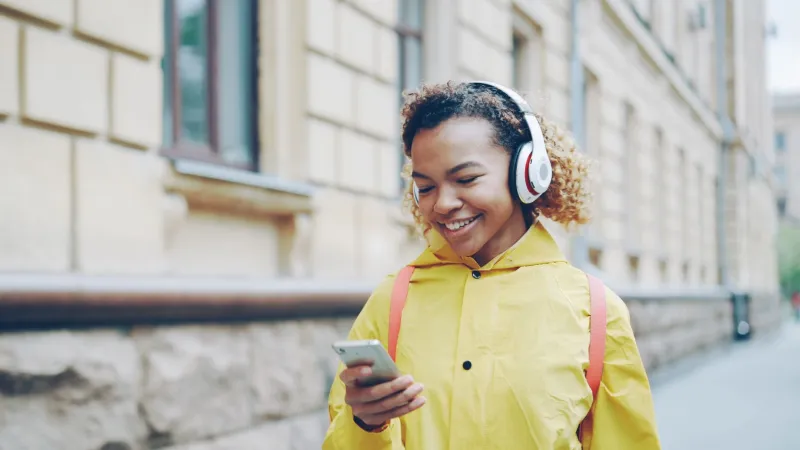
Your Algorithm Knows You Better Than Your Best Friend — And Honestly, You Kind of Love It
Photo: Giles Laurent, CC BY-SA 4.0, via Wikimedia Commons
Every year, right around the time pumpkin spice stops being a personality and holiday anxiety starts kicking in, Spotify drops its Wrapped feature — and the internet collectively loses its mind. People who spent eleven months complaining about algorithmic manipulation suddenly can't stop sharing a slideshow that tells them they're a "tortured perfectionist" who listened to Olivia Rodrigo for 47,000 minutes.
And the wildest part? They're proud of it.
This isn't a drag. It's actually one of the most fascinating things happening in digital culture right now. The Spotify Wrapped phenomenon — and the broader obsession with algorithm-generated self-portraits — says something real and kind of beautiful about who we are and what we're all quietly searching for online.
The Paradox Nobody Wants to Admit
Here's the thing: we live in an era of peak algorithm skepticism. People talk constantly about "breaking free" from recommendation engines, curating their own feeds manually, refusing to let a machine decide what they watch or hear. There are entire Reddit threads dedicated to outsmarting the YouTube algorithm. TikTok detox challenges rack up millions of views — on TikTok.
And yet. The moment Wrapped drops, those same people are refreshing Spotify, screenshotting their top artists, and posting the results with the energy of someone who just got their Hogwarts house confirmed. The contradiction is glaring, but it's also deeply human.
Because here's what nobody says out loud: the reason Wrapped feels different from regular algorithmic curation isn't that it's more accurate. It's that it's retrospective. It's not the algorithm telling you what to listen to next — it's the algorithm reflecting back what you already chose. And that shift from prescription to reflection changes everything.
Data as a Love Language
There's a reason Wrapped feels more like a personality confirmation than a marketing gimmick. When Spotify tells you that you were in the top 0.5% of listeners for Phoebe Bridgers, it's not just a stat. It's a story. It's evidence. It says: this is who you were this year. It validates something you maybe felt but couldn't quantify.
We live in a world that moves incredibly fast, where identity feels slippery and moods shift week to week. The idea that something was quietly keeping score — that there's a receipt for your emotional year — is oddly comforting. Your music taste becomes a kind of autobiography, and Wrapped is the annual edition.
Psychologists have a term for this: self-verification. It's the desire to have your self-concept confirmed by outside sources, even when (especially when) that self-concept is a little messy or contradictory. Wrapped scratches that itch perfectly. It doesn't judge. It just reports. And in reporting, it validates.
Why We Share It (And What We're Really Saying)
The sharing behavior is where it gets really interesting. Posting your Wrapped results isn't just "look what I listened to." It's a curated signal. It's saying: I'm the kind of person who was in their sad girl era in March but came out swinging with hyperpop by August. It's a mood board for your entire year, compressed into a few pastel slides.
In a media landscape where everyone is performing some version of themselves online, Wrapped offers a rare thing — data-backed authenticity. You can't fake 47,000 minutes. The numbers don't lie, which makes them feel more honest than a carefully filtered Instagram grid or a Twitter bio you've rewritten six times.
And because it's universal — everyone gets a Wrapped, everyone shares — it also becomes a social ritual. A moment where the entire Uycial community, and honestly the whole internet, is participating in the same conversation at the same time. That collective energy is increasingly rare, and people are hungry for it.
The Darker Flip Side
Okay, but let's be real for a second. There's a slightly uncomfortable underbelly to all of this.
If your self-image is getting reinforced by an algorithm, that algorithm has enormous power over how you see yourself. Spotify's Wrapped is designed to make you feel good — it's a marketing campaign, full stop. The language is flattering. The data is selectively framed. They're not going to show you a slide that says "you replayed your ex's playlist at 2am more than any other activity this year." They're going to tell you you're a "curious explorer" with "eclectic taste."
So when we lean into Wrapped as a mirror, we're actually leaning into a mirror that Spotify built to make us like ourselves more — and, not coincidentally, to make us like Spotify more. That's not a reason to reject it entirely, but it's worth holding in the back of your mind.
The same goes for every algorithm-driven "personality reveal" moment, whether it's your Netflix top genres, your Apple Music replay stats, or your "most used words" Twitter summary. These platforms are curating your reflection with their own interests in mind. The validation feels personal. The mechanism is corporate.
What It Actually Means for Us in 2024
None of this makes Wrapped less meaningful. Honestly, the fact that a data summary can feel emotionally resonant says more about us than it does about Spotify's engineering team. We are meaning-making machines. Give us numbers and we'll build a narrative. Give us a playlist and we'll build an identity.
What the Wrapped obsession really points to is a genuine hunger — for reflection, for continuity, for someone (or something) to say: I see you, and here's the proof. In a culture that moves so fast that last month feels ancient, having a record of your year is genuinely valuable. Even if that record is a branded slideshow with a shareable format optimized for social engagement.
Maybe the move is to enjoy the ritual without outsourcing the meaning entirely. Let Wrapped be the starting point, not the verdict. Use it to notice things — huh, I really did lean hard into ambient music during that rough patch in February — rather than to define yourself.
Because you are, presumably, more complicated than your top five artists. Although if Phoebe Bridgers, Mitski, and boygenius are on that list, we already have a pretty good idea of what your year looked like.
And honestly? Same.